

Rethinking How Homes Distribute Energy
For more than a century, our homes have been built around the same assumption.
Electricity enters the building at high voltage, power outlets are installed throughout every room, and every appliance is responsible for converting that electricity into the form it actually needs.
It is a system so familiar that we rarely stop to question it.
But perhaps we should.
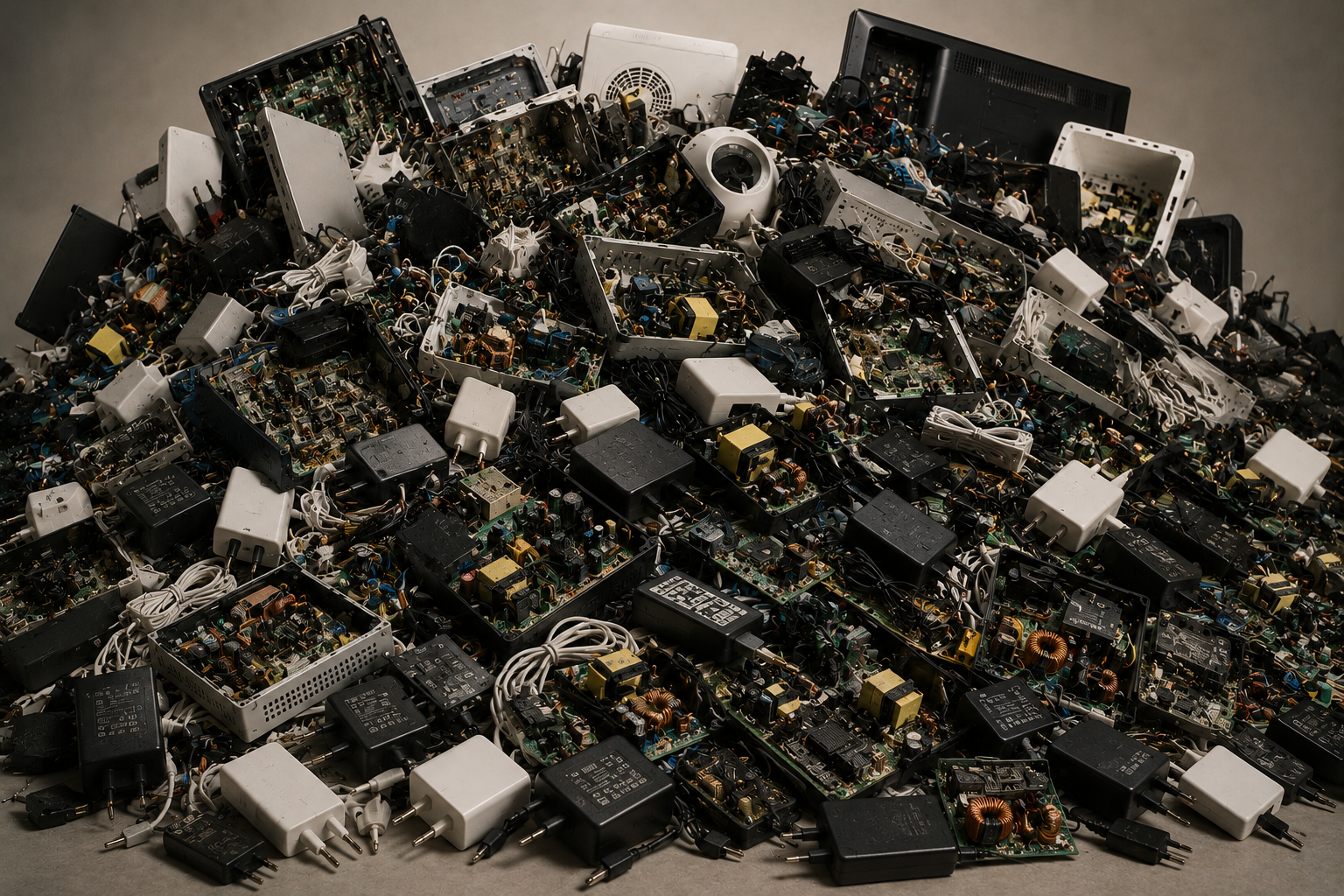
A House Full of the Same Machine
Take a moment to look around a modern home.
A smartphone charger.
A laptop power supply.
A television.
A Wi-Fi router.
An LED lamp.
A monitor.
A security camera.
A smart speaker.
Although they perform completely different tasks, almost all of these devices have one thing in common.
The first thing they do is exactly the same.
They convert mains AC electricity into low-voltage DC power.
In other words, the average home contains dozens of independent power converters, all repeating the same electrical process.
Each one requires its own electronics.
Its own transformer.
Its own components.
Its own enclosure.
Its own manufacturing.
Its own packaging.
Its own eventual replacement.
Multiply that by hundreds of millions of homes, and an interesting question begins to emerge.
Why are we solving the same problem dozens of times inside the same building?
What If Conversion Happened Only Once?
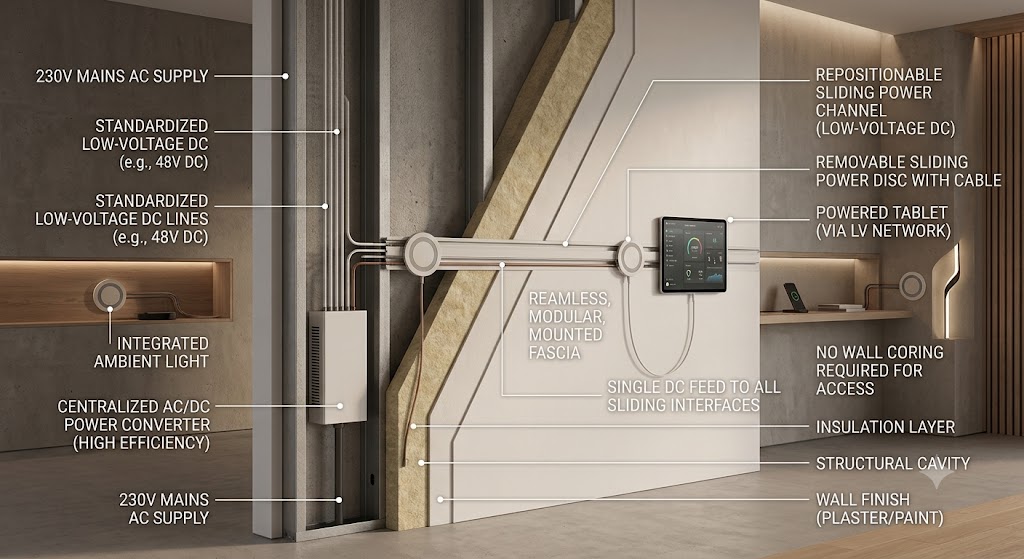
Instead of placing an AC-to-DC converter inside every electronic device, what if that conversion happened only once?
Imagine a home equipped with a centralized, highly efficient conversion system that supplies a standardized low-voltage electrical network dedicated to modern electronics.
Traditional high-voltage circuits would remain exactly where they make sense—for ovens, heat pumps, washing machines, induction cooktops and other high-power equipment.
Everything else could connect directly to a domestic power infrastructure designed around the actual needs of today’s devices.
The idea is surprisingly simple.
Not dozens of converters.
Just one.
The Real Innovation Is Standardization
At first glance, the discussion seems to be about voltage.
Should it be 24 volts?
36 volts?
48 volts?
Perhaps.
But that is not the real innovation.
The revolution is not choosing a specific voltage.
It is establishing a universal domestic standard.
Standards outlive technologies.
The exact voltage may evolve over time as electronics evolve.
The principle remains the same.
A shared electrical language for the devices we use every day.
Sustainability Through Simplicity
We often measure efficiency in watts.
Perhaps we should also measure it in materials.
Every power supply contains plastic.
Copper.
Aluminium.
Magnetic materials.
Electronic components.
Circuit boards.
Packaging.
Transport.
Eventually, waste.
Removing millions of duplicated power supplies would not simply reduce energy losses.
It could reduce the amount of material required to manufacture the electronic products themselves.
Less plastic.
Less metal.
Fewer electronic components.
Fewer failures.
Less electronic waste.
Sometimes the most sustainable object is the one that never needed to be manufactured.
Beyond the Electrical Outlet
Perhaps the biggest limitation is not the voltage.
Perhaps it is the electrical outlet itself.
For generations, architecture has forced energy to emerge from small plastic sockets fixed to walls.
But why should electricity have a single access point?
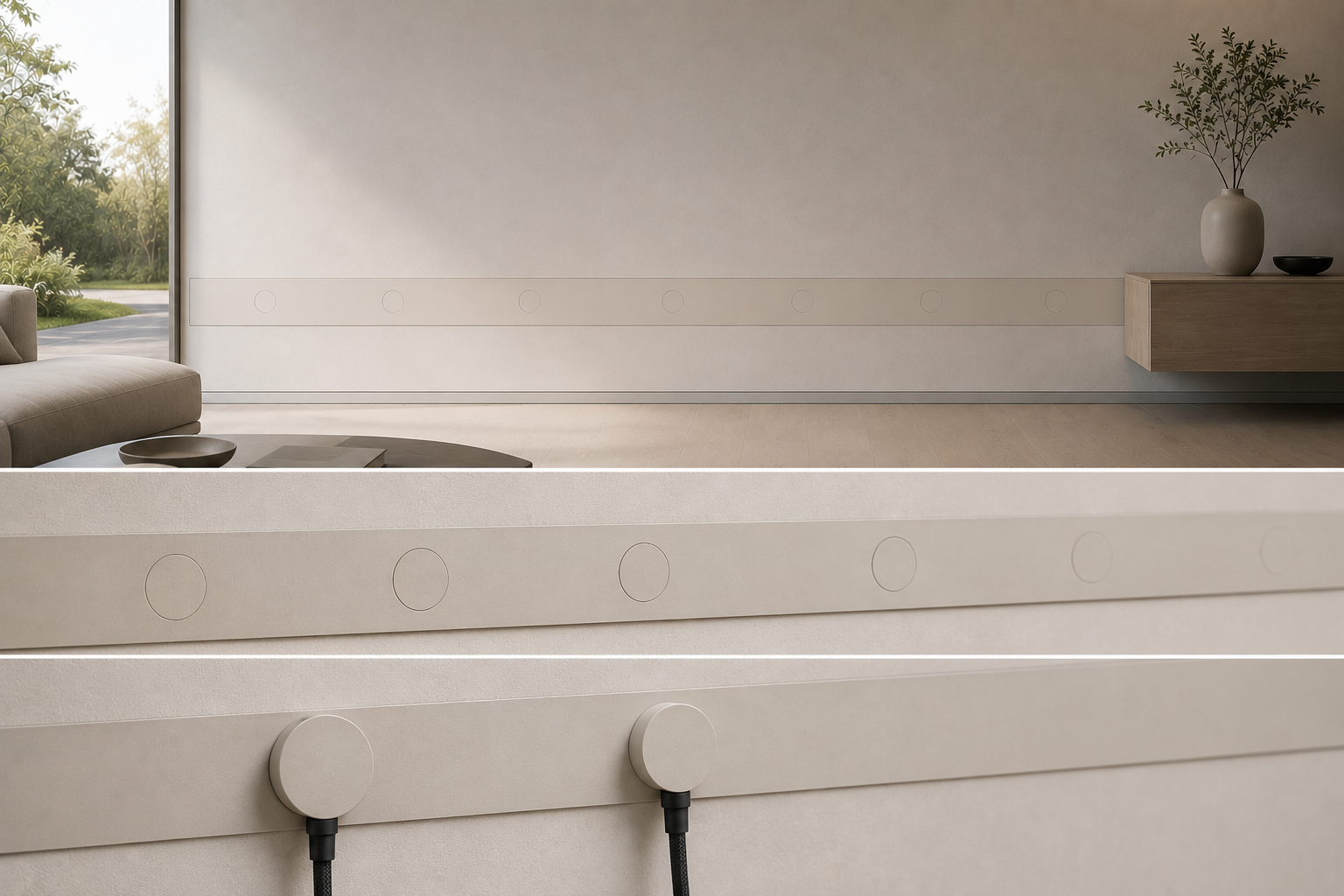
Tomorrow’s buildings could integrate electrical distribution directly into their structure.
Walls.
Furniture.
Shelves.
Kitchen worktops.
Desks.
Workstations.
Instead of searching for an outlet, the building itself becomes the infrastructure.
Energy simply becomes available wherever it is needed.
Almost invisible.
Exactly as good infrastructure should be.
Technology Is Secondary
Whether future connections are magnetic, mechanical, inductive or based on technologies yet to be invented is ultimately a secondary question.
Interfaces change.
Standards evolve.
Engineering improves.
The real transformation lies elsewhere.
It is the decision to stop treating every electronic device as an isolated electrical system and start thinking about energy as a shared resource distributed intelligently throughout the home.
An Economic Opportunity
There is another consequence that often goes unnoticed.
Every time we buy a monitor, a television, a router, a speaker or a charger, we are also buying another power converter.
Consumers repeatedly purchase the same technology without even realizing it.
A centralized domestic conversion system could simplify product design, reduce manufacturing costs, improve long-term reliability and make maintenance easier.
Sometimes innovation is not about adding technology.
It is about removing unnecessary repetition.
A Different Way to Think About Homes
Some elements of this vision already exist.
Data centers, industrial facilities and telecommunications systems have long used centralized power architectures where they offer advantages in efficiency and reliability.
The question is no longer whether the concept is technically possible.
The question is whether the same philosophy should eventually become part of residential architecture.
As homes increasingly generate their own electricity through solar panels, store it in batteries and manage it intelligently, perhaps the way they distribute energy deserves to evolve as well.
A Question Worth Asking
For more than a century, we have distributed electricity throughout our homes using essentially the same model, even though the devices we power have changed beyond recognition.
Perhaps future generations will look at today’s electrical outlets the way we now look at rotary telephones—not as bad inventions, but as solutions designed for a different era.
So perhaps the real question is no longer how to build better chargers.
It is whether the homes of the future should continue distributing electricity according to a model developed more than a century ago.