
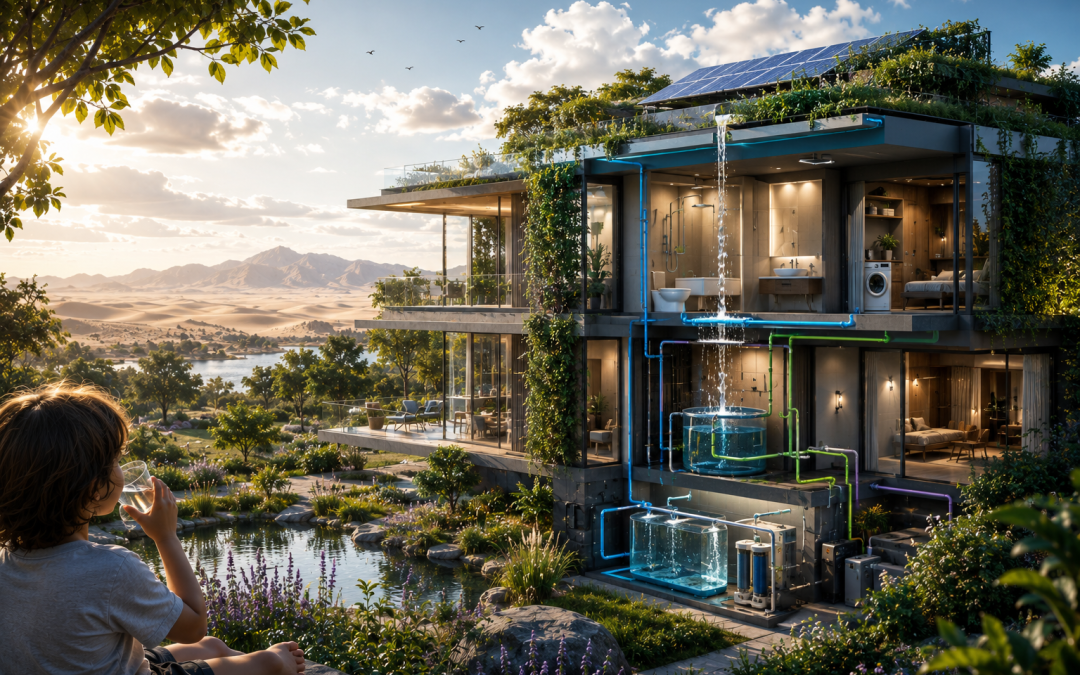
The Water Autonomous Building
Modern buildings are designed around a linear water model. Water enters from the public supply network, is used, and then leaves the building through the sewer system.
This approach has worked for centuries, but it treats water as a single-use resource.
The Water Autonomous Building proposes a different principle: water should remain in circulation for as long as possible before leaving the system.
A Local Water Ecosystem
The building becomes an active water management system rather than a passive consumer.
Rainwater, regenerated water and public water supply become complementary resources within a single local ecosystem.
The objective is not to eliminate the public water network. The objective is to reduce dependence on it by making better use of the water already available.
Multiple Water Sources
The building receives water from three independent sources.
- Public water supply.
- Rainwater harvesting.
- Internal water regeneration.
Rainwater collected from roofs can be stored and integrated into the system.
Water used within the building can be recovered, treated and returned to the cycle.
The public water network remains available whenever additional water is required.
Extending The Life Of Every Liter
The goal is not to use water once.
The goal is to use it several times before it finally leaves the building.
Every additional cycle reduces the demand for newly supplied water.
The building therefore becomes progressively more autonomous and more resilient.
Not A Closed Loop, But An Extended Loop
A completely closed water cycle may not always be necessary or economically practical.
Some uses inevitably remove water from the internal cycle. Toilet discharge is one example.
For this reason, the system continuously receives replacement water from rainfall and, when needed, from the public network.
The objective is not perfection.
The objective is to keep water in circulation for as long as possible.
Technology Will Continue To Improve
The concept is not dependent on any single technology.
Filtration systems, biological treatment, advanced membranes, artificial intelligence, monitoring systems and future innovations may all contribute to the same objective.
The exact technical solutions will evolve.
The principle remains the same: water should not be treated as a disposable resource.
Learning From Space
Humanity already operates advanced water recycling systems in some of the most extreme environments ever inhabited.
If water can be continuously regenerated where every liter matters, there is every reason to believe that increasingly efficient and affordable solutions can be developed for homes, buildings and cities.
A Vision For The Future
The Water Autonomous Building is more than an engineering proposal.
It is a different way of thinking about human settlements.
Buildings should not simply consume water.
They should actively manage, preserve and regenerate it.
As water regeneration technologies continue to advance, future communities may dramatically reduce their dependence on external water resources.
One day, this approach may help make sustainable human settlements possible even in regions where water availability is currently a major limitation.