
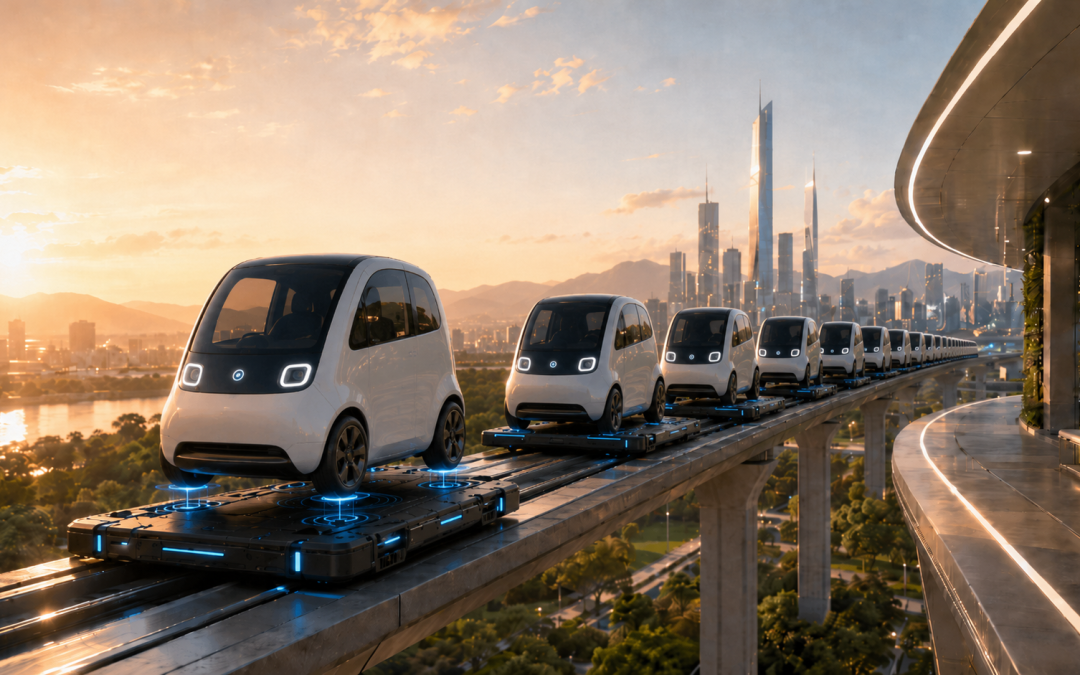
Long‑distance mobility is not driven.
It is transferred by infrastructure.
It is a distinct phase of the journey, governed by infrastructure.
The New Modular Mobility System explores long‑range transport as a process of transfer rather than movement: individual mobility units are temporarily absorbed by an infrastructural flow, carried efficiently across distance, and later released back into local mobility.
In this system, vehicles are conceived as neutral, continuous volumes — smooth, curvilinear and without recesses — not as expressive objects. Their geometry is deliberate: designed to be handled, translated and transported as part of a larger system, without friction, hierarchy or scale conflict.
Beyond a certain distance, mobility stops being automotive and becomes infrastructural.

From Highways to Protected Mobility Networks
The future of mobility cannot be solved simply by building better cars.
For decades, we have tried to make every vehicle more powerful, safer, more autonomous, more intelligent and more efficient. But this approach has a limit: each car is forced to solve problems that actually belong to the system around it.
This proposal moves in a different direction.
Instead of adding more complexity to every individual vehicle, it shifts part of the intelligence, safety, energy management and long-distance performance to the infrastructure itself.
The goal is not just a new kind of vehicle.
It is a new architecture of movement.
A system where small urban vehicles remain simple, affordable and practical, while long-distance travel is handled by a protected, fast and automated mobility network.
The Necessary Separation
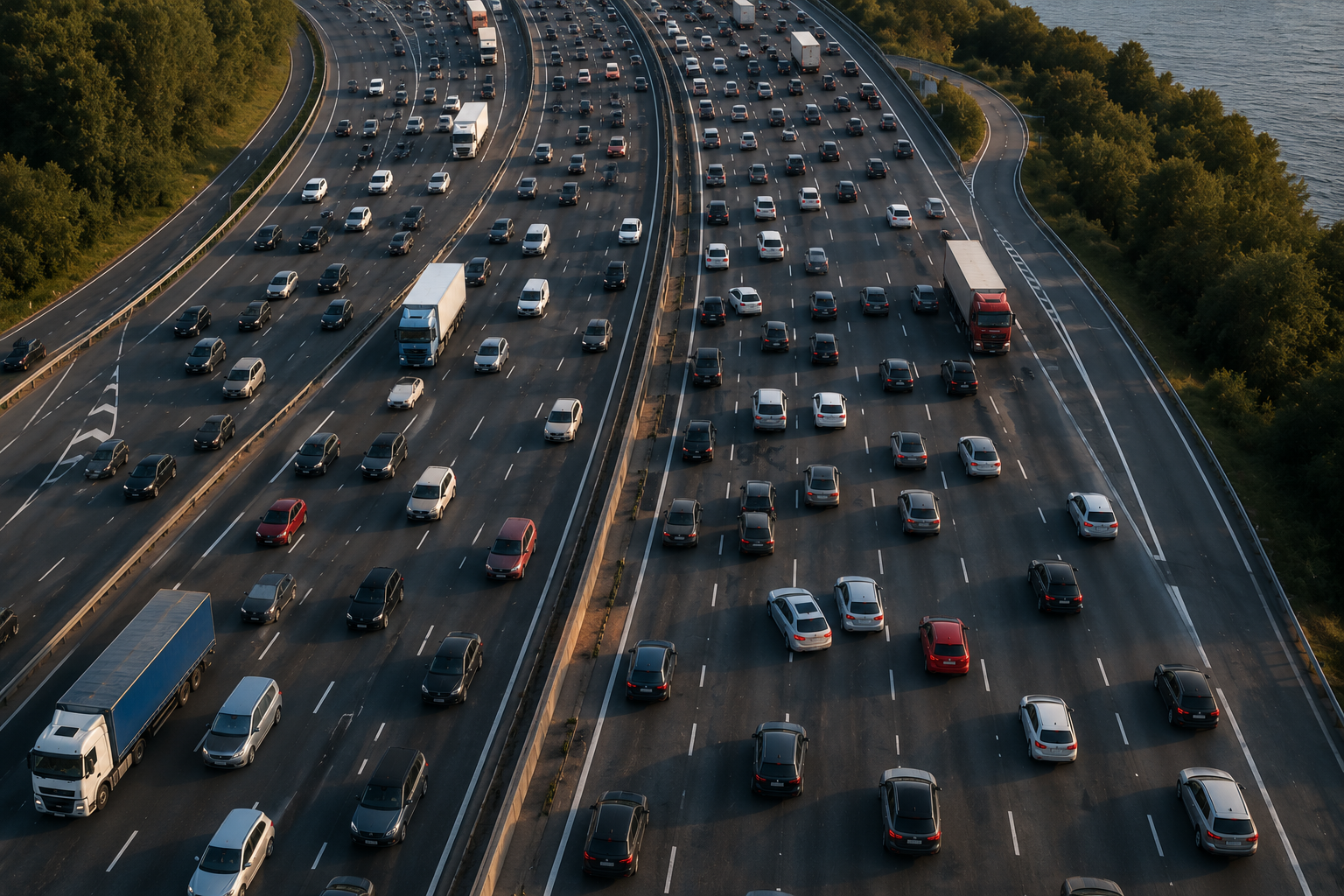
City mobility and long-distance travel are not the same problem.
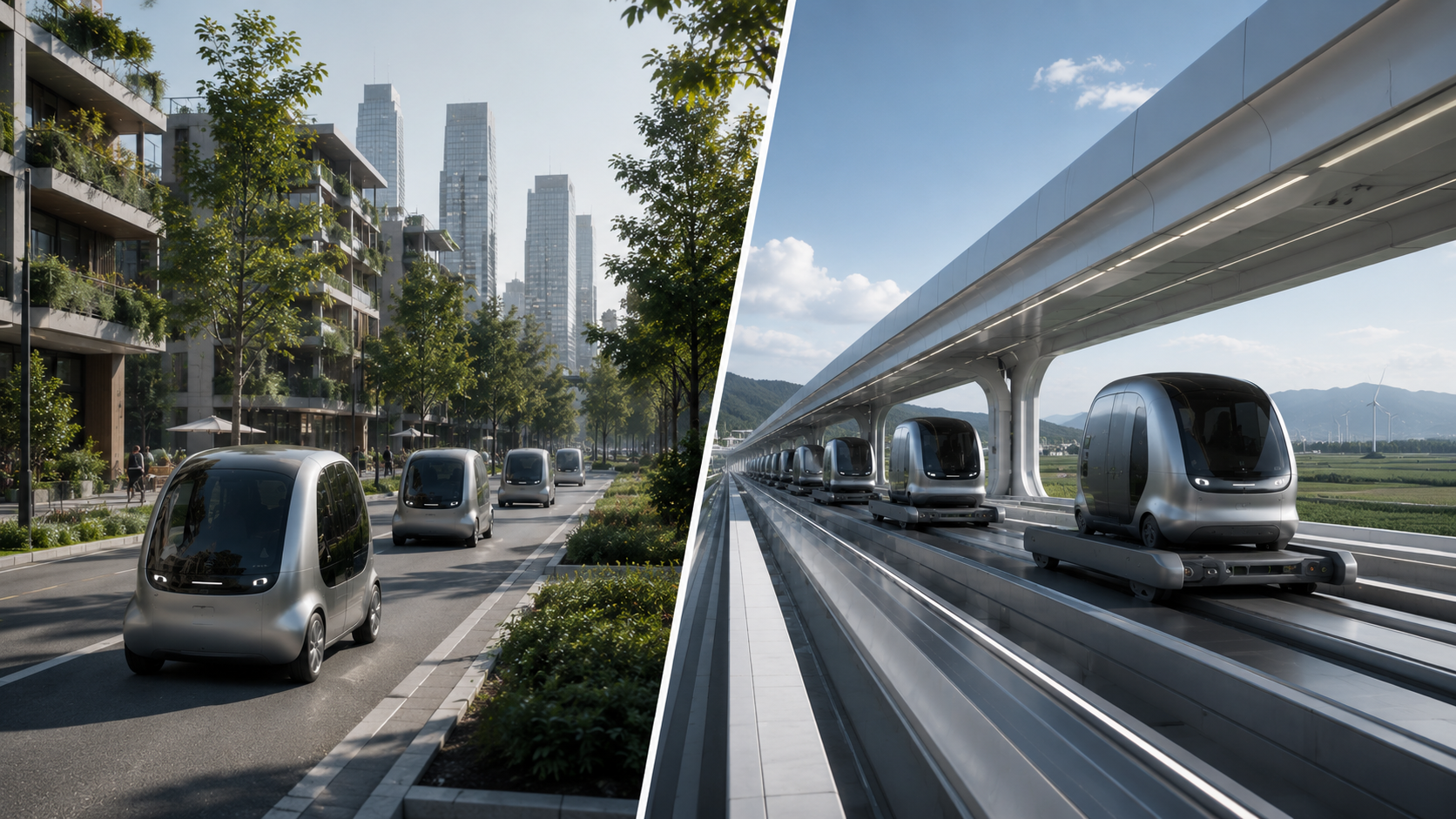
In the city, vehicles need to be slow, compact, accessible, easy to park and suitable for short or medium-range movement. On long distances, the priorities are different: speed, safety, energy continuity and coordination.
The mistake of the traditional car is trying to solve both worlds with the same object.
This is why cars become larger, heavier, more expensive and overdesigned for everyday use.
A new infrastructure makes it possible to separate these two functions: the vehicle remains simple and urban, while the network takes care of fast and protected long-distance movement.
The Protected Network
The central idea is to transform major existing transport arteries, starting from highways, into protected mobility corridors.
Not just asphalt surfaces where every driver manages their own risk, but infrastructures capable of taking control of the vehicle, docking it, transporting it, charging it and releasing it close to its destination.
In this network, the vehicle does not need to drive autonomously through high-speed traffic.
It only needs to reach an access point, position itself on a transport module, complete the docking check and let the infrastructure manage the journey.
Not Autonomous Driving, but Automated Protected Transport
Autonomous driving tries to teach the car how to move through chaos.
This proposal does the opposite: it reduces chaos by creating a protected environment.
On a dedicated network, the system knows the position, speed, distance, destination and docking status of every connected vehicle. Each car no longer needs to interpret the unpredictable behaviour of all the others.
Movement becomes coordinated, verified and controlled by the infrastructure.
This does not eliminate personal freedom.
It places it where it makes the most sense: in the city, in the last mile, in the choice of destination.
Long-distance travel becomes a high-safety service.
The Docking Point
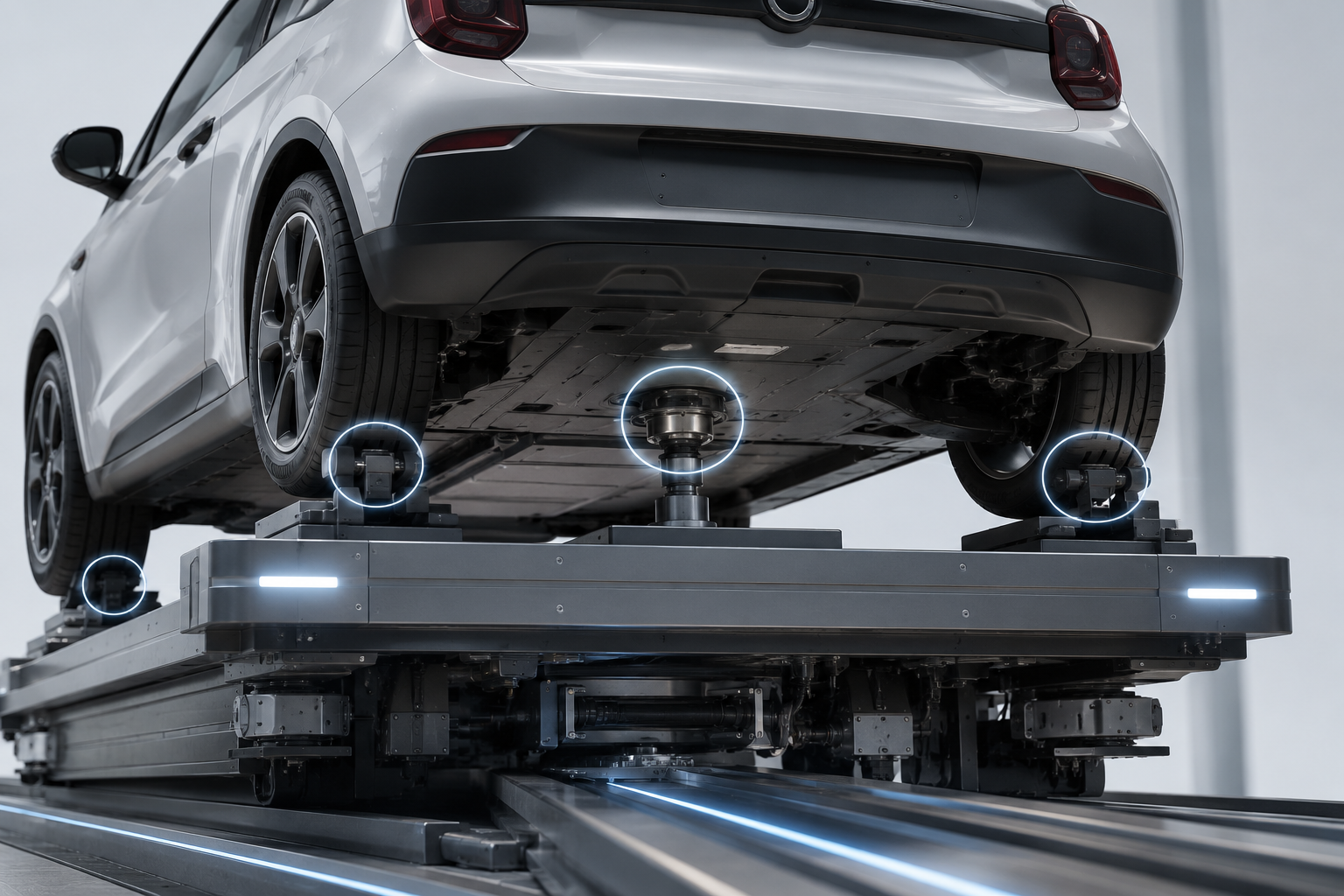
The docking point is the technical heart of the system.
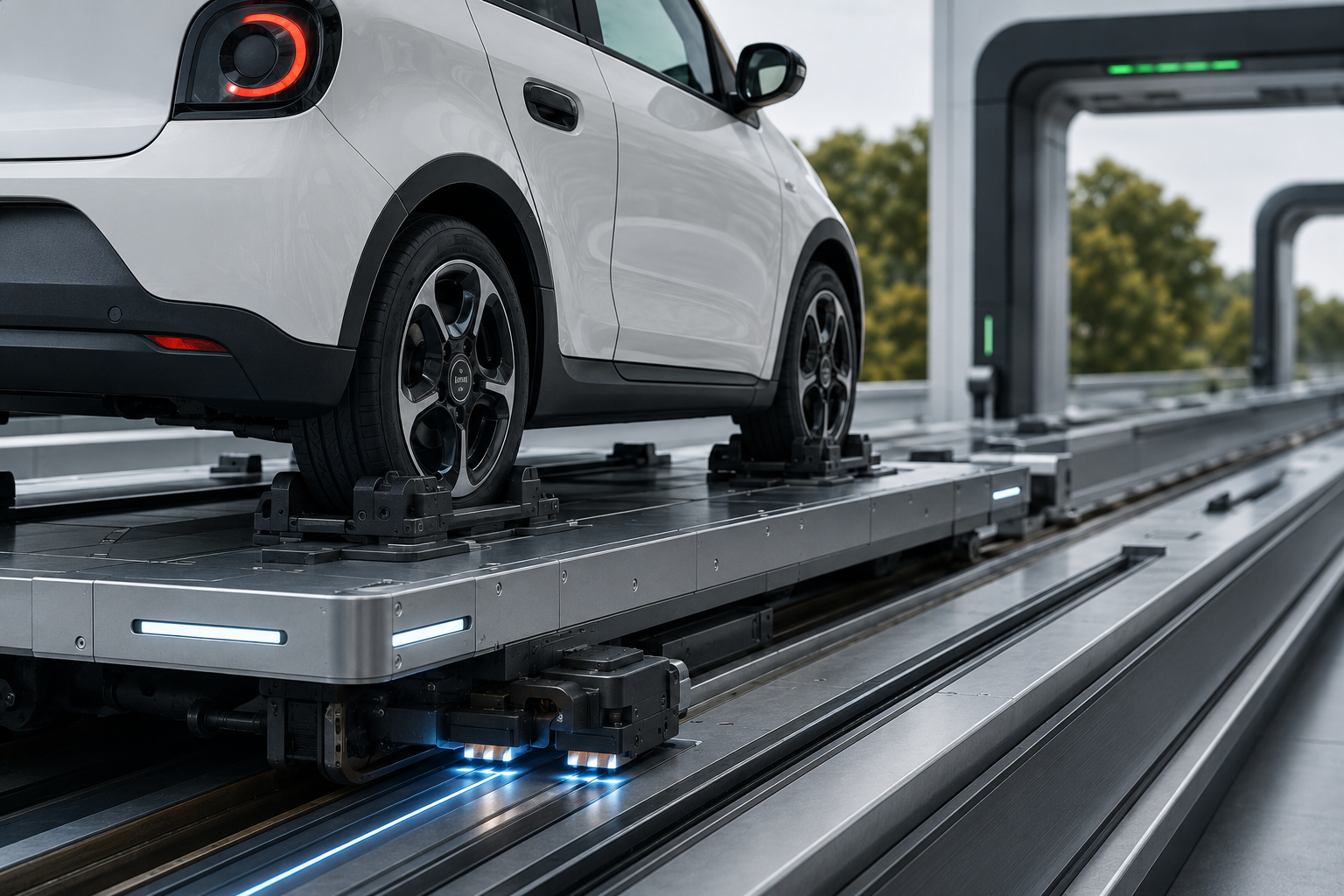
This is where the vehicle changes from urban mode to infrastructure mode. The car moves onto a transport module, even with a small positioning error, and the system corrects, centres, locks and verifies it.
The docking system could be based on a simple and robust standard: one main central point and four lateral points, almost aligned with the wheels.
Each point must confirm correct locking before departure.
If the check is not complete, the system does not authorize movement.
This makes the process safe, repeatable and industrializable.
The user does not need to perform complex manoeuvres.
The infrastructure guides the docking process.
The Transport Module
The transport module should not be a second complex vehicle with traditional wheels.
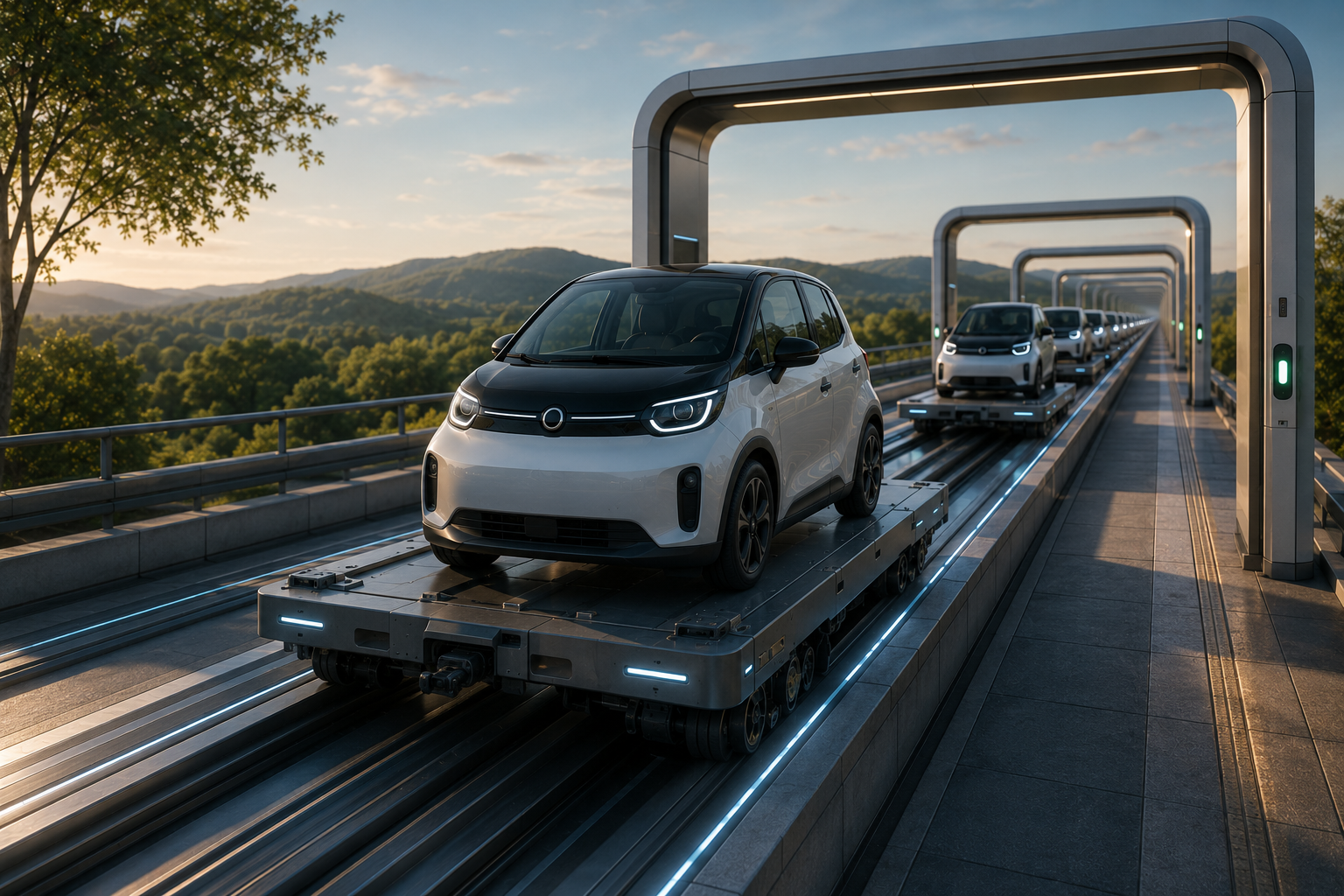
It can be imagined as an essential, robust platform, compatible with a monorail or magnetic guide system. Its role is to support, lock, power and integrate the vehicle into the network flow.
Each module carries one vehicle.
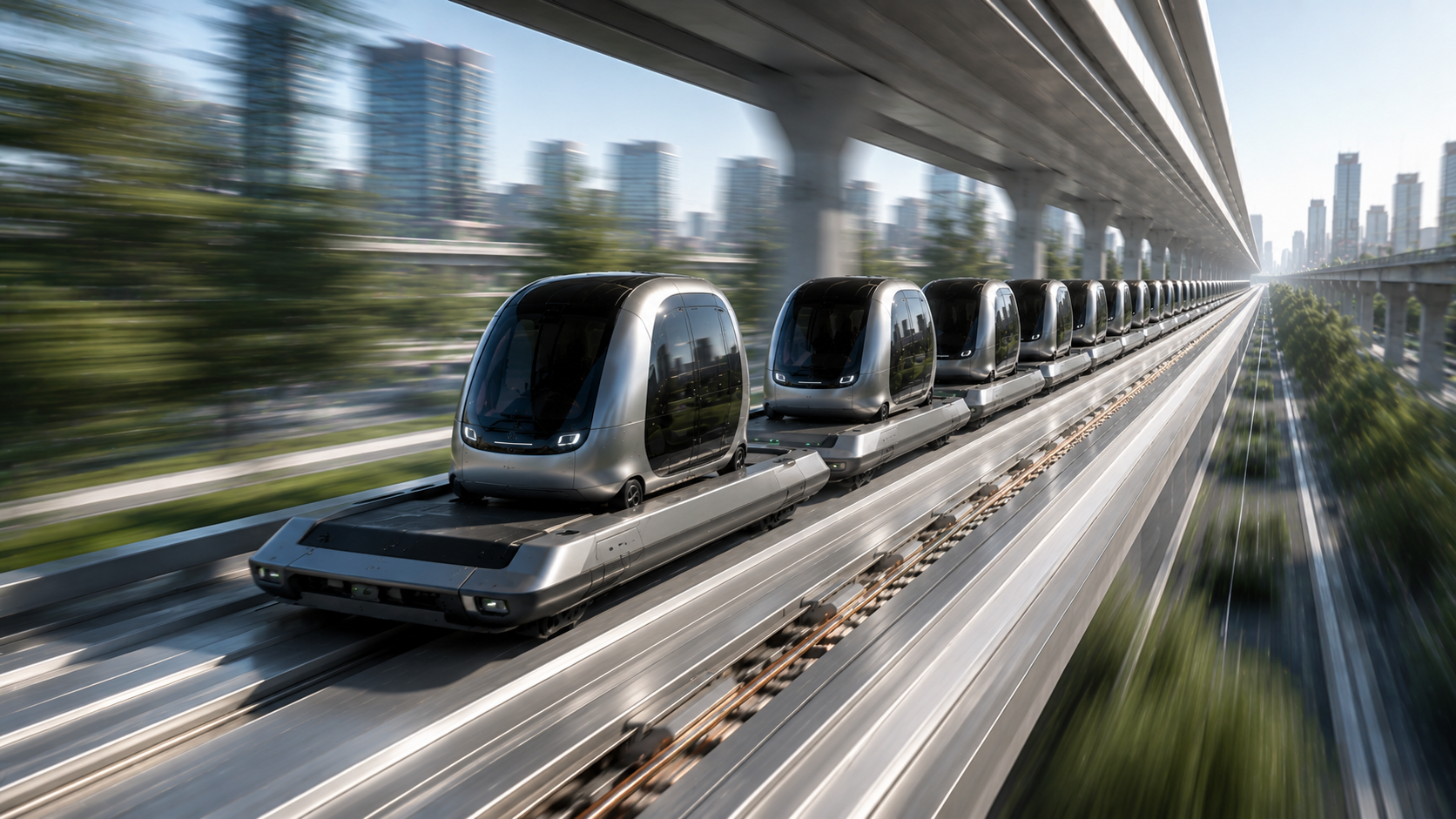
Many modules can connect dynamically, forming convoys of variable length. This solves a crucial problem: the network does not need fixed trains with rigid capacity, but modular elements that can be summoned according to real demand.
If one hundred vehicles need to travel, one hundred modules can be assembled.
If only ten are needed, the convoy will be shorter.
The infrastructure becomes elastic.
Autonomy as a Service
One of the strongest advantages concerns range.
An affordable urban electric vehicle does not need a huge battery. For city use, 50 or 100 kilometres may already be enough for most daily needs.
Increasing battery size too much means increasing cost, weight, material consumption and complexity.
In the protected network, however, long-distance travel does not consume urban range. It extends it.
During transport, the vehicle can be recharged.
Every extra-urban journey becomes an opportunity to recover energy.
This changes the perspective completely: range is no longer only a characteristic of the battery.
It becomes a service provided by the infrastructure.
Systemic Safety
Safety should not depend only on the quality of each individual vehicle or on the attention of the driver.
In a protected network, safety is designed at system level: controlled access, verified docking, coordinated speed, managed distances, separated routes and programmed release points.
This drastically reduces the typical conflict points of today’s highways: overtaking, sudden braking, distraction, fatigue, speed differences and human error.
The network does not simply make travel more comfortable.
It makes it structurally safer.
Autonomy as a Service
One of the strongest advantages concerns range.
An affordable urban electric vehicle does not need a huge battery. For city use, 50 or 100 kilometres may already be enough for most daily needs.
Increasing battery size too much means increasing cost, weight, material consumption and complexity.
In the protected network, however, long-distance travel does not consume urban range. It extends it.
During transport, the vehicle can be recharged.
Every extra-urban journey becomes an opportunity to recover energy.
This changes the perspective completely: range is no longer only a characteristic of the battery.
It becomes a service provided by the infrastructure.
The Evolution of Highways
Highways do not need to be demolished.
They need to evolve.
Their position, routes, connections and logistics nodes already represent an enormous physical base.
The future does not necessarily require new land.
It requires an intelligent transformation of what already exists.
Some lanes could gradually become protected corridors.
Some service areas could become docking points.
Some exits could become access and release nodes.
The existing highway network would become the physical support for a new mobility system.
More Accessible Mobility
By moving complexity into shared infrastructure, the personal vehicle can become simpler and more affordable.
It does not need to be designed to face every extreme condition alone. It does not need to carry a huge battery. It does not need to be a city car, a high-speed car and a long-distance vehicle all at the same time.
This could open the way to lighter, cheaper, easier-to-repair vehicles that are better suited to everyday life.
Personal mobility remains available, but it no longer needs to carry the full technical burden of long-distance travel.
The Final Principle
The future of mobility does not necessarily require smarter, heavier and more expensive cars.
It may require a smarter system around a simpler vehicle.
The question is not: how can we build cars capable of doing everything?
The question is: which functions should belong to the vehicle, and which should belong to the network?
This proposal starts from a precise answer:
local freedom belongs to the vehicle;
speed, safety and extended range belong to the infrastructure.